The ancient and medieval gates of Constantinople have been described by several historians and chroniclers. Patriarch Constantine, Cedrenus, Xonaras, and Symeon Magister provide important references to the city’s gates, walls, and nearby harbors. These sources record both natural disasters, such as fires, and the construction or repair of gates that connected the city to its harbors. For example, Symeon Magister records a fire near the Harbour of Sophia and the Iron Gate, which destroyed the Church of St. Thomas, showing that these landmarks were close together The Prison of St. Diomed.
The Gate of Sergius and Bacchus
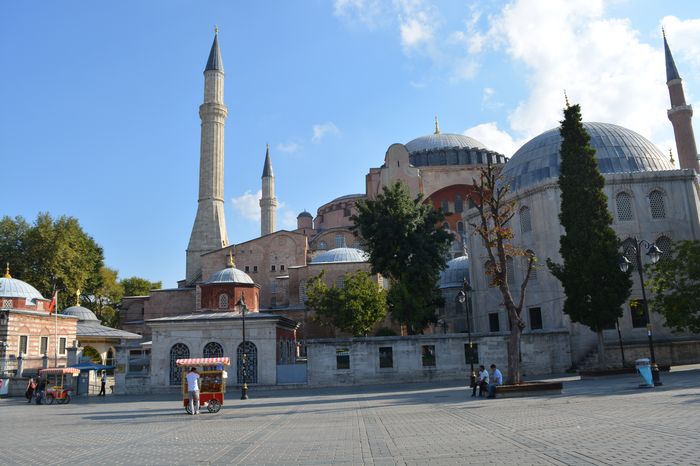
One of the gates, adorned with a remarkable Latin inscription, was dedicated to Sergius and Bacchus and is located near what is now the Mosque of Sultan Ahmed. The inscription is a cento, or a collection of verses, taken from the Book of Habakkuk and the Psalms. These verses were modified slightly to celebrate the triumph of an emperor over his enemies. The inscription records that the king destroyed the forces of his enemies and was supported by God, who punished the wicked and protected the righteous.
The stones carrying this inscription were clearly reused from an older building when the postern or small gate was built or repaired. Such inscriptions were common in Byzantine architecture, showing both piety and imperial power.
The Gate of Sophia
The next significant entrance, the Gate of Sophia, was closely linked to the Harbour of Sophia. In Greek, it was called Porta Sidhera due to the iron used in its construction. After the Turkish conquest of Constantinople, it was renamed Porta İvaterga Limani, meaning the Gate of the Harbour of the Galleys. This gate connected the city with the main harbor where warships and galleys were docked Private Guide Turkey.
The Porta Kontoscalion
The Porta Kontoscalion was another important gate, connecting to the Harbour of the Kontoscalion at Koum Ivapoussi. This gate provided easy access to the naval harbor and was a key point for trade and military movements. Its location highlights the close connection between the city walls and Constantinople’s harbors.
Yeni Kapou and Daoud Pasha Kapoussi
Following this is the gate called Yeni Kapou, located in the quarter of Vlanga. A Latin inscription above the gate confirms it as a Byzantine construction, though its original name has been lost. It was situated near the Harbour of Theodosius, also known as the Harbour of Eleutherius.
Immediately to the west of Vlanga Bostan was the gate now called Daoud Pasha Kapoussi, historically known as the Gate of St. Emilianus. This gate took its name from a nearby church dedicated to St. Emilianus. It was the westernmost entrance of the Constantinian Walls along the Sea of Marmara. Near this gate stood the Church of St. Mary Rhabdou, which was venerated as the site where the rod of Moses was kept.
These gates and their surrounding landmarks illustrate the strategic, religious, and civic importance of Constantinople’s walls. Each gate was connected to harbors, churches, and major thoroughfares, combining military defense, commerce, and religious observance. The inscriptions, reused stones, and surviving names help modern historians trace the city’s complex layout and the continuity between Byzantine and Ottoman eras.