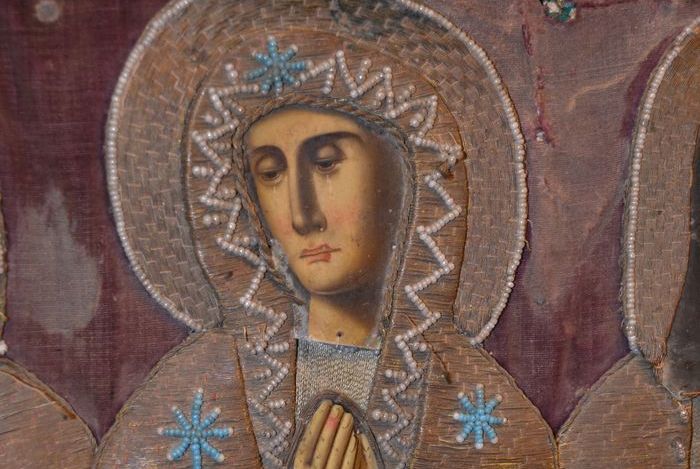
The text above discusses the feast of All Saints and its iconography in Christian art. The Feast of All Saints celebrates all the holy people, known and unknown, who are part of the Church. It is an important feast that shows the unity of the faithful, often called the “Communion of Saints” (Communio Sanctorum). In the Orthodox tradition, this feast is usually commemorated on the first Sunday after Pentecost. The feast reminds believers that holiness is open to everyone and that all saints share in the glory of God Central Iconographic Structure of the Composition.
Sources and Scholarly References
Many scholars have studied the feast and its iconography. Important studies include the works of H. Frank, H. Feuerstein, and other researchers who wrote about All Saints in theological and art historical dictionaries. These studies explain how the feast developed and how its visual representation was shaped by theology and liturgical tradition. Later publications, such as those connected with the Stavronikita Monastery and other academic works, also describe examples of icons and their artistic details. These sources help us understand how the image of All Saints became a stable and meaningful theme in Christian art.
Biblical Foundations of the Iconography
The iconography of the Feast of All Saints is mainly based on the Book of Revelation, especially chapters 5, 7, 19, and 22. These chapters describe the heavenly worship of God and the gathering of the righteous before the divine throne. Artists used these biblical visions as a model for showing a large assembly of saints in heaven. The saints are usually arranged in ordered groups, showing harmony and spiritual unity. This arrangement reflects the idea that all the saints share in eternal life and divine glory Sofia Day Trips.
Historical Development and Palaeologan Period Evidence
The presence of this iconographic theme can be seen in epigraphic and artistic material from the Palaeologan period. At least one known example from this time is the so-called “Vatican jacket,” which shows early forms of this visual tradition. Scholarly works by researchers such as N. Ikonomidis and G. M. Lechner discuss these examples and their historical importance. Their studies demonstrate that the theme of All Saints was already well established during the late Byzantine era and continued to develop in later centuries.
Theological Interpretation and Relation to the Last Judgment
The theological meaning of this iconography is closely related to the Last Judgment and especially to the Second Coming of Christ. However, unlike full Last Judgment scenes, the icon of All Saints often does not show hell or the punishment of sinners. Instead, it focuses on the righteous and their participation in divine glory. In this sense, the image can be understood as a peaceful and hopeful vision of salvation. It presents the Second Coming in a symbolic way, emphasizing the victory of holiness rather than judgment and fear.
Artistic Tradition in Crete and Mount Athos
This subject was painted in many icons produced in the artistic centers of Crete and Mount Athos. One of the earliest known examples is found in the Dionysiou Monastery on Mount Athos and is attributed to the Cretan painter Nikolaos Ritzos. This icon dates from the late fifteenth to the early sixteenth century and shows the early development of the theme. Another example from the eighteenth century, said to come from Macedonia and now in the Ekonomopoulos Collection in Thessaloniki, confirms the continued popularity of the subject.
Composition and Iconographic Details
In Cretan painting, artists preferred a clear and organized separation of the saintly figures. The Hetoimasia (the prepared throne) is often placed prominently, sometimes in front of figures such as Saints Constantine and Helena with the True Cross. The depiction of Paradise can vary in landscape and details, but certain elements remain constant. These usually include the Penitent Thief and the Old Testament patriarchs holding the souls of the righteous. Such details reinforce the message of salvation and eternal life, which stands at the center of the Feast of All Saints iconography.